
This is one of those updates that sounds small, but is not.
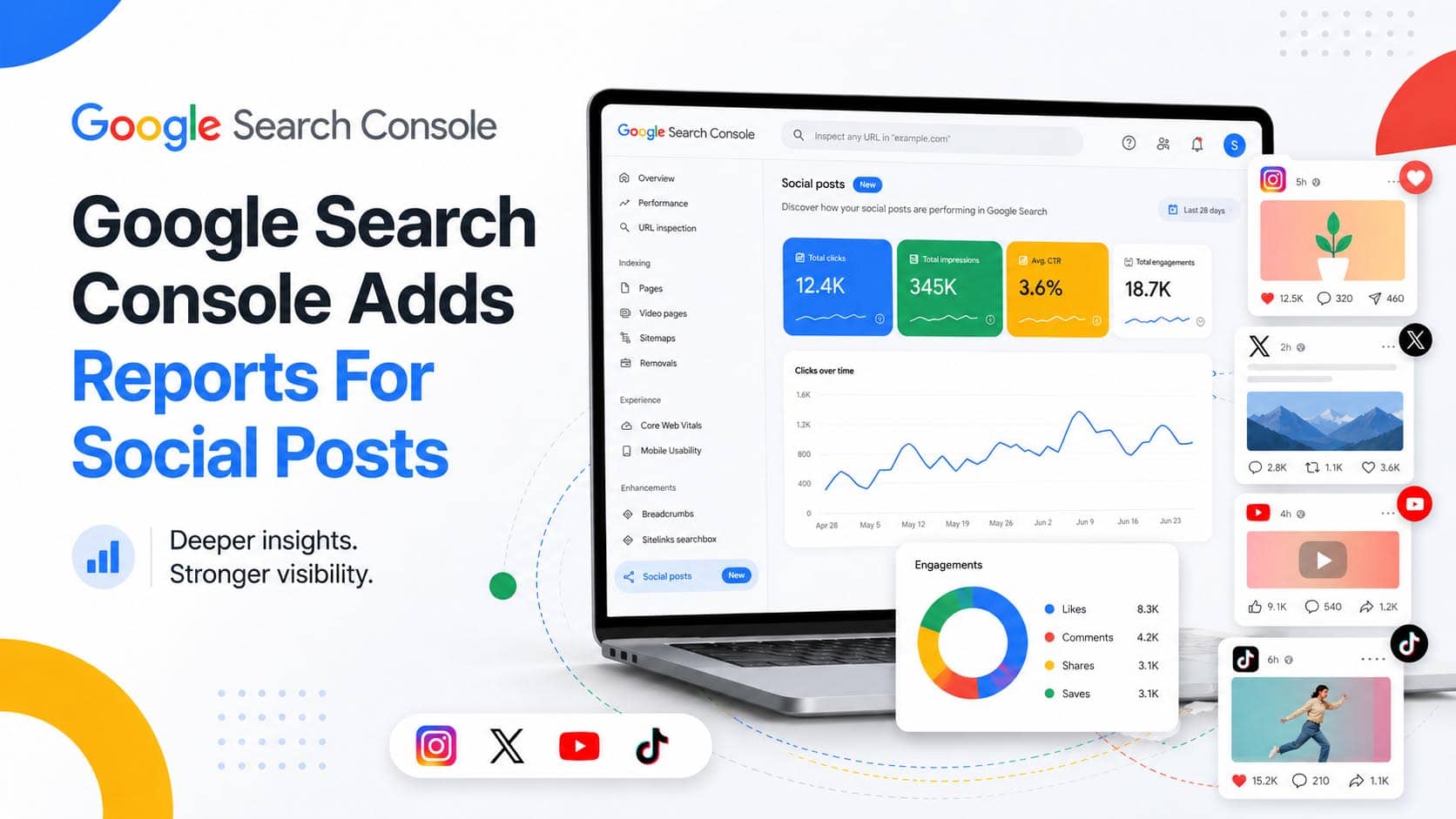
Google has rolled out platform properties in Search Console, allowing you to track how your Instagram, TikTok, X and YouTube content performs across Google Search, Discover and News.
In other words, your social posts are now measurable inside the same tool you use for SEO.
That changes the conversation.
What has actually launched?
Search Console now supports a new property type specifically for platform accounts.
You can add supported profiles such as Instagram, TikTok, X and YouTube directly within the property selector, alongside your website.
Once verified, you can see:
- Clicks
- Impressions
- Search queries
- Average position
- CTR
All within the familiar Performance reports.
And this is not limited to brands with websites. Creators can add a platform property without owning a domain.
The global rollout completed in late July 2026.
In plain English
Google has indexed social and video content for years.
Now you can see the data.
Instead of guessing whether your Instagram post appears for a search, you can check.
Instead of assuming your YouTube Short might surface in Discover, you can measure it.
That is a shift from visibility by assumption to visibility by evidence.
What this is not
This is not in-app social analytics.
You will not see:
- Instagram reach
- TikTok watch time
- Native engagement metrics
This shows how your social content performs within Google surfaces.
Search. Discover. News.
It is search visibility for off-site content.
Why this matters commercially
For years, SEO reporting centred on one asset. Your website.
But Google increasingly surfaces entity-level content. Brand accounts. Creator channels. Short-form video.
Now those assets are measurable inside Search Console.
That means:
- A TikTok can drive measurable search clicks
- An Instagram post can surface for informational queries
- A YouTube channel can attract search demand before users ever hit your site
For B2B and service brands, this is assisted pipeline visibility.
For e-commerce, it is product discovery insight.
For personal brands, it is proof of authority in search.
Search is no longer website-only.
It is ecosystem-wide.
What good looks like
Do not just connect it and leave it there.
Use it.
Look for:
- Queries driving impressions to social posts
- Posts ranking but underperforming on CTR
- Platforms outperforming your website for awareness terms
- Query themes that deserve deeper SEO landing pages
Then align the ecosystem.
If Instagram ranks for early-stage queries, support it with an SEO page that captures intent.
If YouTube drives high-impression queries, consider PPC to capture bottom-funnel demand.
If social content surfaces for niche topics, Digital PR can strengthen authority around them.
Web. SEO. PPC. Digital PR. Social.
Measured together.
60-second action
Open Search Console.
Click Add property.
Select the relevant platform.
Connect one account.
Then check which queries are already triggering impressions.
If there is data, optimise it.
If there is not, that tells you something too.
The bigger shift
Google has effectively confirmed that social and video content are first-class search assets.
By giving them their own property type, it is bringing off-site visibility into the core SEO reporting stack.
That is not cosmetic.
It signals a broader move towards entity-driven search and measurable multi-channel presence.
If you only optimise your domain, you are underestimating your searchable footprint.
If you only report on website clicks, you are under-reporting performance.
The opportunity is not to publish more.
It is to connect what you publish, measure it properly and build visibility across the full digital ecosystem.
That is where strategy compounds.